Physical Sciences
Physics, Chemistry, Materials

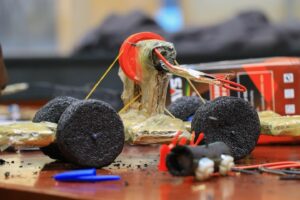
Uganda National Secondary School Science Fair
Secondary school students design a real project, write a real proposal, and defend it in front of judges — from a school fair, to a regional fair, to the national fair. No laboratory required.
Program Overview
The program introduces talented secondary school students to scientific research, engineering design, innovation, and entrepreneurship. Students work alongside university faculty, engineers, scientists, and industry professionals to develop practical solutions to real-world challenges while building the skills that prepare them for university and STEM careers.
Why Join?
How it works
Projects advance from a school-level fair, to a regional fair, to the national fair. Dates for each stage are announced to schools each year.
Every school partner receives the Student Research & Innovation Handbook and the Proposal Workbook.
You pick a problem worth solving and a teacher agrees to mentor you. Nothing starts without a mentor.
The completed Proposal Workbook, signed by you, your mentor and your head teacher. Every project submits one before any experimenting, building or fieldwork begins.
At least two independent reviewers score the proposal out of 100 against a standard rubric, checking safety, ethics and feasibility. You get written feedback either way.
You run the project you proposed, keeping records as you go — data, receipts, and what went wrong as well as what worked.
You present at your own school first.
Selected projects go forward to the regional fair.
The Uganda National Secondary School Science Fair, with awards across categories and special recognitions for innovation, community impact and scientific rigour.
Categories
Every project is entered in one category. Choose the one your work sits in most naturally — judges compare projects within a category, not across them.
Physics, Chemistry, Materials
Biology, Agriculture, Ecology, Public Health
Devices, Mechanical and Electrical Systems, Renewable Energy
Applications, Websites, Data Systems, AI Tools
New Products, Business Models with a Technical Core
Projects that change something where you live
Example Student Projects
A student-built solution for testing water quality.
Using technology to support farmers.
A low-cost solution for agriculture.
Exploring how UAVs can support healthcare access.
Smarter, safer roads through technology.
Early warning to protect communities.
Clean power for homes and schools.
Turning waste into opportunity.
Program Impact
Research Facilities
Annual Research Symposium
Every participating student presents their research at the Jdiobe STEM Research Symposium before judges from universities and industry. Award categories may include:
Who may enter
The Science Fair is open to students enrolled at a Ugandan secondary school, entering individually or as a team, supervised by a teacher mentor.
You do not need a laboratory, and you do not need previous research experience. The strongest projects usually come from noticing something wrong close to home and being stubborn about measuring it.
Exact class levels, any age limits and maximum team size are confirmed with schools each year when the handbook is released.
Nothing. There is no entry fee, and no money passes to your school.
The Foundation may fund part of an approved project where there is demonstrated need, based on the itemised budget in your workbook. Funding is never guaranteed, and it is not required to take part — plenty of strong projects cost almost nothing.
The proposal
The Proposal Workbook walks you through twenty-two sections. It is long on purpose: most of it is teaching, and you fill in the blanks as you go.
Who is affected, where, how seriously, and how you know. A topic is not a problem statement — the workbook shows the difference with a worked example.
At least five sources, and a summary in your own words of what is already known and what is not.
SMART objectives, then the research questions or the design specifications your project has to meet.
The scientific method or the engineering design process, your variables and controls, and a numbered procedure someone else could follow.
Consent, animal welfare, environmental impact, a risk assessment matrix and emergency contacts. Every project completes this, however safe it looks.
Every AI tool used, where, and how. Grammar, brainstorming, translation and coding syntax are fine. Generating your idea, data or conclusions is not.
Itemised in Ugandan Shillings, with a supplier or quote reference against each line, and a note on where each figure came from.
Month-by-month plan, expected results and how the project keeps its value after the fair.
Download
Read the handbook before you start. Fill in the workbook as you go — it is designed to be worked through, not filled in at the end.
Apply
Tell us who you are and what you want to work on. This is the online step; the formal submission is the completed workbook, signed by you, your mentor and your head teacher, with the school stamp.
Frequently Asked Questions
We invite universities, companies, researchers, engineers, sponsors, and schools to support student research and help build Africa's next generation of innovators.